
Issue 12 · August 3, 2026
Brent Lost Ten Dollars in a Week Everything Got Worse. Escalation No Longer Buys a Premium.
The market has stopped pricing escalation and started pricing throughput, so Brent's 10% fall to $87.93 during the worst week the chokepoints have had means headlines now buy nothing and only a physical stoppage, or a ceasefire shipowners believe, moves the price.
This Week · The nine dollar Monday · Volgograd fire, record revenue · Saudi crude turning north
Lead Story
Brent Lost Ten Dollars in a Week Everything Got Worse. Escalation No Longer Buys a Premium.
A two day pause in American strikes took nine dollars off the price on a single Monday, and a week of tanker seizures, a Red Sea blockade and a burning Russian refinery did not put one dollar back.
Brent crude, the global oil price benchmark, settled at $87.93 a barrel on Friday 31 July, down almost 10% from $97.72 the previous Friday. Almost the entire loss came in one session. Brent fell 8.7% on Monday 27 July to $88.36 after Iran said it would suspend attacks for as long as an American pause in hostilities held. Then the pause failed. Washington resumed strikes on Iranian targets, Iran's Revolutionary Guards stopped two tankers inside the Strait of Hormuz and turned four more around, the Houthis held the blockade they imposed on Saudi linked shipping on 20 July, the Caspian Pipeline Consortium terminal on the Black Sea suspended loadings again after fresh attacks, and Ukrainian drones set fire to Lukoil's Volgograd refinery on the night of 30 to 31 July. After all of that, Brent finished the week 43 cents below the level the diplomatic scare had knocked it to five days earlier.
The price has stopped paying for headlines and started paying for throughput. Kpler, the ship tracking firm whose vessel data the trading desks actually use, counted about 6.5 million barrels of oil a day leaving the Gulf through Hormuz over the past week, against roughly 33 commodity vessel crossings a day between 15 June and 7 July and fewer than five a day on 22 July. The market has been burned twice on the reopening trade since June, so it now discounts announcements and pays only for barrels physically missing. That makes the risk asymmetric in a way almost nobody is positioned for: escalation headlines buy nothing, while a verified ceasefire still costs the full premium. The gap between the US Energy Information Administration's forecast of $70 Brent for the fourth quarter and Friday's $87.93 screen is $17.93, about 26%. OPEC+, the group of major producers that jointly manages output, agreed on Sunday 2 August to add 188,000 barrels a day in September, finishing the unwind of its 2023 cuts and planning to hold levels flat for the rest of the year, so no further paper supply is coming to close that gap. For a European investor the rule for the next 30 to 90 days is to stop trading the headlines and start watching the crossing count. Brent holds $80 to $95 while Gulf throughput stays near 6.5 million barrels a day, breaks above $95 only if flows fall durably below 5 million, and prints the mid $70s within two weeks of a ceasefire that shipowners actually believe.
Chart · Ship Traffic Through the Strait of Hormuz
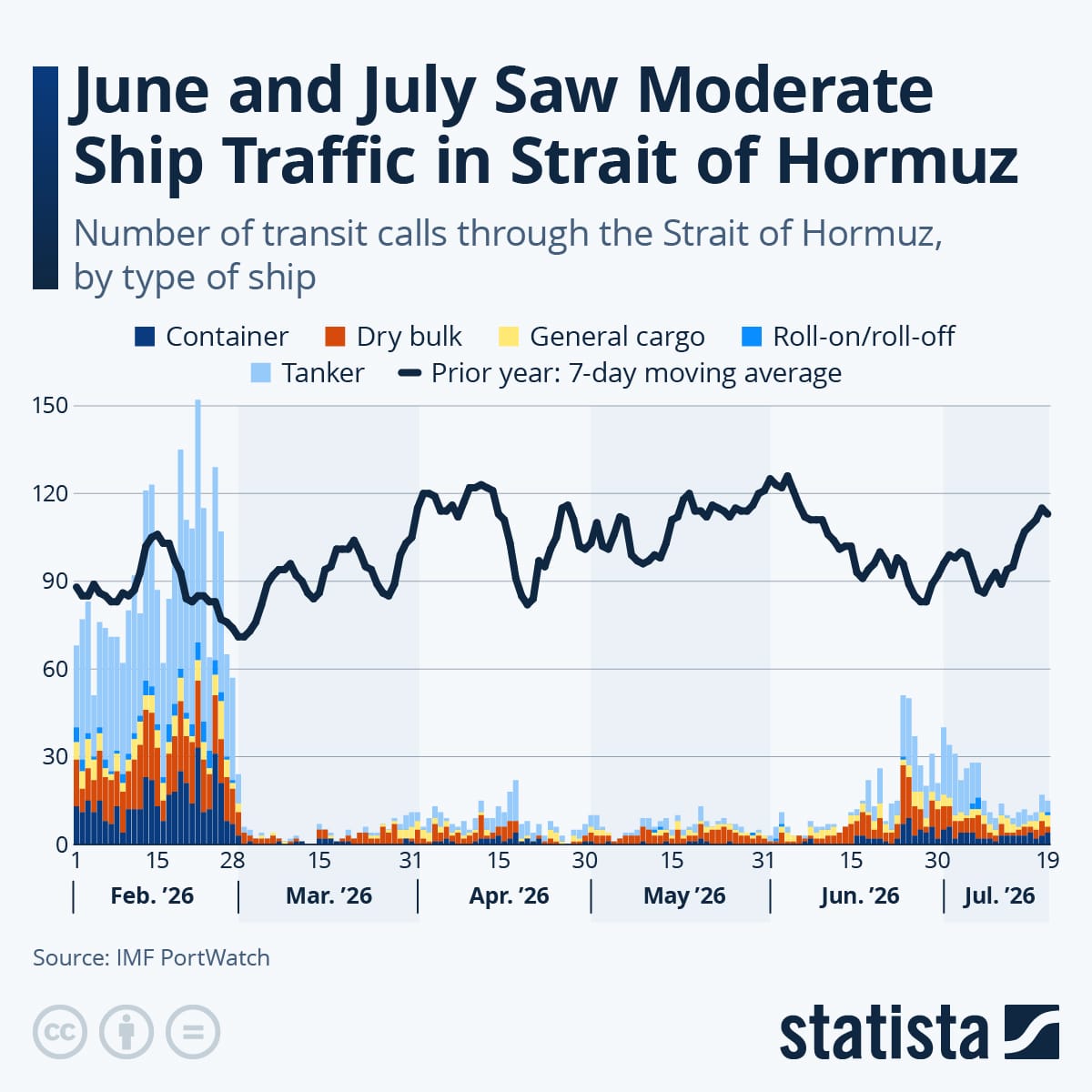
Transit calls through the Strait of Hormuz by ship type, 1 February to 19 July 2026, set against the prior year's seven day moving average. Crossings collapsed from a prior year norm near 100 a day to almost nothing from March, and the brief mid June recovery above 50 died inside a fortnight. The line worth trading runs along the bottom of this chart, not across the headlines. Source: Statista, using IMF PortWatch data.
Escalation headlines buy nothing, while a verified ceasefire still costs the full premium.
Geopolitics
Ukraine Is Burning Russian Refineries in the Month Russia Posts Its Best Oil Revenue of the War.
The Gulf has paid Moscow more per barrel than Kyiv's drones have taken away in volume.
On the night of 30 to 31 July, Ukrainian Defence Intelligence struck Lukoil's Volgograd refinery, the largest in Russia's Southern Federal District at roughly 14.8 million tonnes of crude a year and a direct fuel supplier to the Russian armed forces, and the same wave of drones flew more than 1,100 kilometres further east into Tatarstan. It was the deepest night of the campaign so far. It moved Brent by 1.21%. In the same month, Reuters projects Russia's oil and gas revenue up about 60% against a year earlier, with the Finance Ministry due to publish the July figure on 5 August. That is the arithmetic Europe keeps refusing to state plainly: the premium the Gulf war added to every barrel has been worth more to the Russian budget than the refining capacity Ukraine has destroyed, so the fuel duty a German or Spanish household paid this summer travelled partly to the treasury financing the war on Europe's eastern border. Central and Eastern Europe pushed hardest for the price cap architecture that a market this hot has simply routed around, and it is now watching the volume weapon and the price weapon cancel each other out in real time.
In Focus · Freight
The Houthi Blockade Is Quietly Pushing Saudi Crude Toward Europe.
The barrels that cannot go south through Bab al-Mandeb have one way out, and it points at the Mediterranean.
Total crossings through Bab al-Mandeb, the chokepoint at the southern end of the Red Sea, have fallen about 35% since the Houthis announced their blockade on Saudi linked shipping, with only 11 tankers crossing on 27 July. Of roughly 3.2 million barrels a day that normally leave Saudi Arabia's western coast at Yanbu heading south toward Asia, the ship tracking firm Kpler expects 2 to 2.5 million barrels a day to reroute north through the Suez Canal once August loading cargoes are committed. North means the Mediterranean. The story being told everywhere is that the Red Sea is closing to Europe. The flow data says close to the opposite: a blockade aimed at Saudi shipping bound for Asia hands European refiners physically closer Saudi barrels, and the number that confirms it is Saudi Aramco's next official selling price, the monthly formula the company sets separately for each destination market. A cut to the Europe formula relative to Asia is the rerouting showing up in the price, and it is the most underpriced piece of good news in an otherwise brutal quarter for European refining costs.
Take Action
Five Signals to Watch This Week
Concrete checkpoints between now and the next issue.
- Track the Hormuz crossing count rather than the headlines. Kpler publishes vessel level crossing data weekly, and the only thing that matters is whether daily commodity transits hold above the recent lows for more than a few days.
- Read the next EIA Short-Term Energy Outlook. Its $70 fourth quarter Brent forecast sits $17.93 below Friday's screen, and the revision it makes is the cleanest read on whether official models are capitulating to the war premium.
- Watch Russia's Finance Ministry release on 5 August. Reuters projects July oil and gas revenue up about 60% year on year, and the outturn tells you whether Ukraine's refinery campaign is denting the budget or the Gulf premium is outrunning it.
- Mark Saudi Aramco's next official selling price for Europe. A cut relative to Asia confirms Saudi barrels rerouting north through Suez and is a direct margin tailwind for European refiners.
- Check EU gas storage weekly on the AGSI+ dashboard at agsi.gie.eu. Storage near 55% against a seasonal norm around 67% means every quiet week now becomes a cold January later, with TTF at 59.07 euros already 73.88% above a year ago.