
Issue 13 · August 10, 2026
The Market Bought a Reopening. Iran Sold a Toll Booth.
Brent fell $4.38 to $83.55 pricing a Hormuz reopening, but the Iran and Oman draft does not reopen the strait, it installs Tehran as its harbourmaster, so the de-escalation discount is wrong and Brent holds above $80 through Q3.
This Week · Hormuz toll booth · Gas storage 18 year low · Four refineries in one week
Lead Story
The Market Bought a Reopening. Iran Sold a Toll Booth.
Brent fell 4.38 dollars on a document that makes Tehran the harbourmaster of a fifth of the world's seaborne oil.
Brent crude, the global oil price benchmark, settled at $83.55 a barrel on Friday 7 August, up 1.29% on the day but down $4.38, about 5%, from the $87.93 it closed at a week earlier. One story did that. Iran said on Thursday that it had agreed the geographical coordinates of a shipping corridor through the Strait of Hormuz with Oman, and the market read it as a reopening. Then Iranian state media published what the draft says. American and Israeli vessels are banned from the strait outright. Violators face fines of up to 20% of cargo value. Countries and individuals Tehran deems to have damaged Iran are refused passage through the strait and the Persian Gulf until Iran is compensated for war damages. Iran takes responsibility for navigation guidance, vessel traffic monitoring, maritime security and environmental protection. Parts of the new inbound and outbound corridors run through Iranian rather than Omani waters, reversing an arrangement decades old. And none of it applies until Washington lifts its blockade of Iranian ports first.
That is not a reopening. It is a change of harbourmaster, and the difference is the whole trade for the next 30 to 90 days. A ceasefire removes a risk; this document relocates it, permanently, into the hands of the state that closed the water in February. Gulf producers have already rejected Iranian management of the strait as a gross violation of international law and an attack on the International Maritime Organization, which means the draft has to survive Washington, Riyadh and Abu Dhabi before a single insurer reprices a single hull. Set that against the official forecast. The EIA, the United States government agency that publishes the American energy outlook, still has Brent averaging $70 a barrel in the fourth quarter of 2026, which is $13.55 below Friday's screen, about 19%. That gap is the market's estimate of how much of this conflict is permanent, and it is too small. The market discounted the end of a blockade this week and ignored the birth of a toll. Brent holds above $80 through the third quarter, and the four dollars taken off this week are handed back the moment a treaty banning American ships reaches an American government that will not sign it.
Chart · The Official Forecast Against the Screen
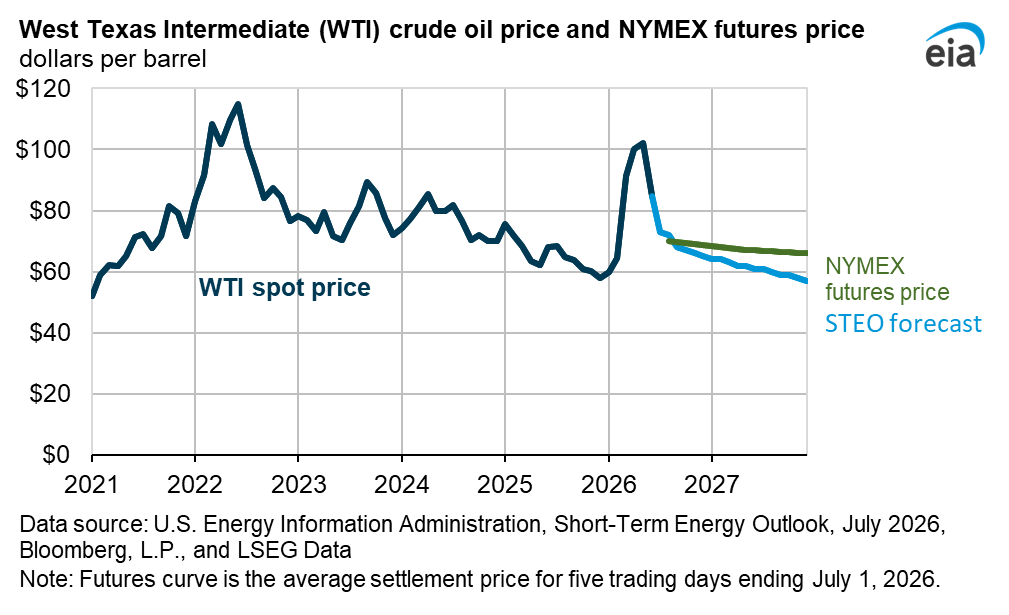
The chart plots West Texas Intermediate, the United States crude benchmark, in dollars per barrel from 2021 to 1 July 2026, then the EIA forecast path and the NYMEX futures curve out to the end of 2027. Its data stops five weeks before the week described above, so it cannot show Friday's move. What it does show is the official model itself: a spike above $100 in early 2026, then a forecast falling below $60 by late 2027 while the futures market prices closer to $65. WTI settled at $78.18 on Friday 7 August, above the level where that forecast path even begins. Source: US Energy Information Administration, Short Term Energy Outlook, July 2026, built on Bloomberg and LSEG price data.
That is not a reopening. It is a change of harbourmaster, and the difference is the whole trade for the next 30 to 90 days.
Geopolitics
Ukraine Burned Four Refineries. Moscow Had Its Best Revenue Month of the Year.
The Kremlin budget is being carried by price, not volume, which makes a Gulf peace deal the sharpest sanction on the table.
Between Wednesday and Saturday, Ukrainian long range drones hit the Bashneft Novoil refinery at Ufa on 5 August, the Slavneft Yanos plant at Yaroslavl on 6 August, and the Ilsky and Syzran refineries overnight into 8 August. Yaroslavl is one of the five largest refineries in Russia. Ilsky processes more than 6 million tonnes of crude a year and Syzran 8.5 million. It was the heaviest week of the campaign so far, and on 5 August, in the middle of it, Russia's Finance Ministry published 934 billion rubles of July oil and gas revenue, about $11.9 billion, the best month of 2026, beating the ministry's own forecast by 291.9 billion rubles and running 36.6% above June. The two facts fit together in only one way. Russia's 2026 budget is being carried by price, not by volume, which means the war premium that raised what a German or an Austrian household paid this summer has been worth more to the Kremlin than every refinery Ukraine has burned. It also means the inverse. A genuine Hormuz reopening that pulls ten dollars out of Brent would take more money out of Moscow in a quarter than the drone campaign has taken out in a year, and Central and Eastern Europe, which pushed hardest for a price cap architecture this market has simply routed around, would finally see the volume weapon and the price weapon pointing the same way.
In Focus · Navigation
The Ships Already Signed. The Treaty Is Just Paperwork.
Most vessels crossing Hormuz on Friday were already sailing Iran's own routing scheme.
Kpler, the ship tracking firm whose crossing counts have become the market's read on the strait, logged eight confirmed crossings of the Strait of Hormuz on 7 August, down 33% on the previous day, and noted that most of them used what it calls the Iranian Unilateral Scheme, the routing Tehran designated on its own authority. For the last full week before that, 27 July to 2 August, Kpler recorded 106 crossings by 96 distinct vessels, just over 15 a day against more than 100 a day before the war, with 43 of those crossings, about 41%, classified as route undetermined because the ships were sailing with their transponders switched off. The dark share fell from 49% the week before, which reads as progress until you notice what the two numbers say together. Shipping has already accepted Iranian routing and still does not trust it enough to broadcast a position. Kpler's Dimitris Ampatzidis put the reason plainly: operators need a sustained reduction in the risk of attack, detention and misidentification, and confidence has to return across shipowners, flag states, insurers, charterers and crews, so normal transponder behaviour will recover more slowly than the crossing count. A Bloomberg terminal shows you the signing. It does not show you that the lane was already Iranian three days before anyone signed anything, and that is the number that prices freight.
Take Action
Five Signals to Watch This Week
Concrete checkpoints between now and the next issue.
- Read the draft terms, not the headline. The clause that matters in the Iran and Oman text is not the 20% fine, it is Iran taking responsibility for navigation guidance, traffic monitoring and maritime security, because a toll can be repealed and a jurisdiction cannot.
- Read the EIA Short Term Energy Outlook when it publishes on Tuesday 11 August at eia.gov/outlooks/steo. July's edition had Brent at $70 for the fourth quarter, $13.55 below Friday's $83.55 close, and the size of the revision is the cleanest read on whether the official model is capitulating to the war.
- Track the dark AIS share, not the crossing count. Kpler had 41% of Hormuz crossings route undetermined in the week to 2 August, down from 49%, and a fall below 25% is the reopening the price should actually pay for.
- Check EU gas storage weekly on the AGSI+ dashboard at agsi.gie.eu. European inventories stood at 57.15% of capacity on 2 August, the lowest for that date in records going back to 2009, with Germany near 47% while Poland sat near 85%, so the winter risk is national, not continental.
- Mark Saudi Aramco's October official selling price. September's Arab Light to Asia went to $2 under the Oman and Dubai average, the lowest since June 2020, and if October cuts Europe less deeply than Asia the rerouting of Red Sea barrels north through Suez is finally showing up in the price a European refiner pays.