
Issue 14 · August 17, 2026
Demand Fell the Most Since the Pandemic. The Shortage Got Deeper.
The International Energy Agency cut its 2026 oil demand forecast again this week, to an annual fall of 1.6 million barrels a day, the largest collapse in oil consumption since 2020. Oil finished the week up almost 6%, at 88.52 dollars.
This Week · IEA deficit at 1.8m b/d · Vance and Kyiv target list · Record diesel cracks
Lead Story
Demand Fell the Most Since the Pandemic. The Shortage Got Deeper.
The IEA cut consumption by 1.6 million barrels a day and widened its deficit in the same report, because supply is vanishing almost three times faster.
Brent crude, the global oil price benchmark, settled at 88.52 dollars a barrel on Friday 14 August, up 4.97 dollars and almost 6% on the week, 4.20% on the month and 34.43% on the year. TTF, Europe's benchmark wholesale gas price, settled at 61.43 euros per megawatt hour, a three week high and up more than 10% on the week. Both moved on the same document. The International Energy Agency published its August Oil Market Report on Wednesday 12 August and cut world oil demand for 2026 by a further 510,000 barrels a day, taking the expected annual fall to 1.6 million barrels a day, the steepest decline since the pandemic year of 2020. In the same report it cut supply harder, to a fall of 4.3 million barrels a day against the 3.7 million forecast in July, and lifted its third quarter deficit to 1.8 million barrels a day, more than double last month's estimate and the deepest quarterly shortfall since the end of 2021. Global observed crude inventories have fallen 410 million barrels since the war began and dropped below 7.9 billion barrels in July for the first time since April 2025.
For most of this year the bearish case for oil rested on demand destruction, the idea that high prices would kill enough consumption to cap the price. That argument has now arrived in full and it has stopped working. The agency published the demand collapse the bears were waiting for and a deeper shortage in the same sentence, because supply is disappearing roughly 2.7 times faster than the demand it destroys. The official models have started to agree. The United States Energy Information Administration, the government body that publishes the monthly Short Term Energy Outlook, raised its 2026 Brent average to 87 dollars on Tuesday 11 August and lifted its fourth quarter forecast to 78 dollars from the 70 dollars it carried in July. The residual gap to Friday's screen is 10.52 dollars, and its direction matters more than its size, because this is the second month running in which an official forecaster moved toward the market rather than the market moving toward the forecast. Brent holds above 85 dollars through the third quarter. The European consequence is not on the crude screen but at the pump and the boiler, where heating oil futures ended Friday 92.49% more expensive than a year ago against crude's 34.43%.
Chart · IEA Demand and Supply Balance
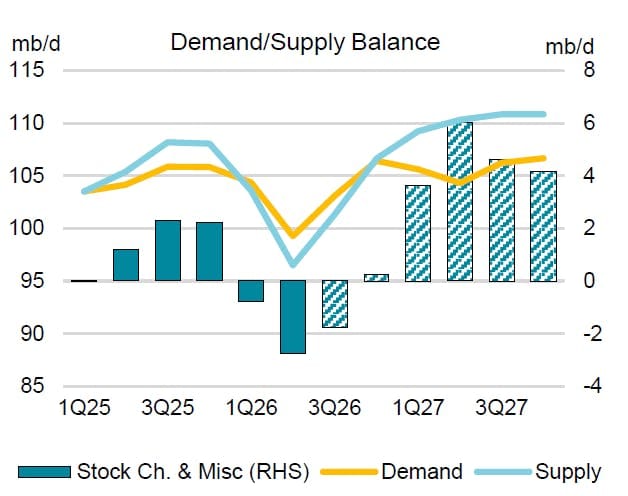
Quarterly global oil demand, supply and implied stock change, first quarter 2025 to fourth quarter 2027, in millions of barrels a day. The demand line and the supply line both fall through 2026, but supply falls further and crosses below demand, and the balance bars on the right hand scale turn negative from the start of 2026, reaching the deepest quarterly stock draw anywhere on the chart in the second quarter. The hatched bars from the third quarter of 2026 onward are forecast, which matters, because the large 2027 surpluses the chart shows are the ones the agency says depend entirely on hostilities easing and disrupted flows recovering. Source: IEA Oil Market Report, August 2026, via Oil and Gas Journal, 12 August 2026.
The agency published the demand collapse the bears were waiting for and a deeper shortage in the same sentence, because supply is disappearing roughly 2.7 times faster than the demand it destroys.
Geopolitics
Washington Is Now Editing Ukraine's Target List by Oil Price
Kyiv stopped hitting tankers when the Vice President asked. It did not stop hitting refineries, and Europe pays for the half that continues.
Ukrainian forces suspended drone attacks on oil tankers at the port of Novorossiysk following a request from United States Vice President JD Vance, the Financial Times reported on Wednesday 12 August, citing Ukrainian officials, and Washington also asked Kyiv to stop striking non Russian tankers in the Black Sea. The stated reason was the Caspian Pipeline Consortium, the line that carries about 80% of Kazakhstan's crude exports to the Black Sea and which an American official described as a vital conduit of Kazakh energy for European markets and an alternative to Russian supply. Two drone driven shutdowns of that route since June cut Kazakh production to about 1 million barrels a day at the end of July from more than 2 million in June. Vance said this week that cheap oil and gas is the top American priority in the Iran war. The refinery campaign continued regardless. Ukraine hit Gazprom's 200,000 barrel a day Neftekhim Salavat plant in Bashkortostan on Thursday 13 August, and the 120,000 barrel a day Orsknefteorgsintez refinery in Orenburg has halted completely, with the regional governor saying repairs could take six months because sanctions make the damaged equipment hard to replace. Europe should read the line that was drawn. Strikes that lift the crude price an American driver sees were stopped. Strikes that destroy refining capacity, and therefore lift the diesel and heating oil prices a European household sees, were not. The sanctions architecture that Central and Eastern Europe pushed hardest to build is now being edited in Washington according to a pump price measured in Ohio.
In Focus · Refining
The Barrel Is Up 34%. The Diesel Is Up 92%.
The crack spread, not the crude price, is the number that reaches a European invoice.
The diesel crack spread, the margin between what a refiner pays for crude and what it earns selling diesel, topped 98 dollars a barrel on Thursday 13 August, a record, after Houthi forces struck Saudi Aramco's 400,000 barrel a day Jazan refinery on the Red Sea coast for the second time in five days. Global refinery crude throughput ran at 80.9 million barrels a day in July, nearly 5 million below the same month last year, and the IEA expects utilisation to fall a further 370,000 barrels a day this quarter. Russian fuel exports have collapsed to 1.4 million barrels a day, close to half their July 2025 level, and Russian seaborne product exports fell 33% in July from June alone. The IEA reports refining margins in the Atlantic Basin at record highs. Crude is a global auction and Europe can outbid for it. Refined diesel is a manufacturing problem, and Europe imports the shortfall from a world that has lost 5 million barrels a day of processing capacity. On Friday heating oil futures were 92.49% dearer than a year ago while Brent was up 34.43%. A terminal shows both prints. It does not tell you that the distance between them is the part of this war that arrives as an invoice rather than a headline.
Take Action
Five Signals to Watch This Week
Concrete checkpoints between now and the next issue.
- Read the IEA August Oil Market Report at iea.org. The number to find is the 1.8 million barrel a day third quarter deficit, and the sentence to find is the one making the 2027 surplus conditional on hostilities easing.
- Track the diesel crack spread rather than Brent. It set a record above 98 dollars a barrel on 13 August and it is the input to European haulage, farming and heating costs, none of which are visible in the crude price.
- Watch whether the EIA raises its forecast again in September. It moved its fourth quarter Brent forecast from 70 to 78 dollars on 11 August, and a second consecutive increase means the official model has stopped treating this war as temporary.
- Follow the Aramco October official selling price for Europe. September cut Arab Light to Asia to a six year low, and an October round that treats Europe better is the first hard evidence of Red Sea barrels rerouting north.
- Check EU gas storage weekly on the AGSI+ dashboard at agsi.gie.eu. TTF is back above 60 euros with inventories at their lowest seasonal level in the series, and Qatari cargoes are not expected to reach European buyers before early in the fourth quarter.